meetlancer

Tuesday, June 5, 2012

The votes of Edo electorate must count

Adam Oshiomhole, Edo State Governor
By Paul Arhewe

Edo State is attracting cover headline news once again, no thanks to the imminent gubernatorial election in the state fixed for next July 14. Already on display is the usual melodrama where the dramatist personae devise dirty schemes to outwit one another. Characteristically, the electorate are relegated to the background.
As politicians are busy heating up the system they usually see dirty antics and ploys as primal to winning elections. This recurring trait is undeniably fast becoming a stratagem for electioneering in Africa’s largest democracy. How politicking in Nigeria got so messy and pathetically undemocratic should be not only a concern of the authorities, the problem should be fixed. Politicians should allow the electorate to freely exercise their franchise to decide who should rule them. I cannot help but wonder why Nigerian electorate are not wooed with realistic manifestoes and campaigns promises?

Tuesday, May 22, 2012

Nigeria’s ill timed military foray in West Africa

Nigerian soldiers
By Paul Arhewe

It is rather perplexing that it is when there are knots to untie in the continent that the magnificence and might of Nigeria is overtly and absolutely embraced. Juxtaposing the gains the country has received from her big brother sacrificial roles in Africa with the accruable benefits, what one sees is a non-commensurate reward. Why this assessment one may ask? Nigeria’s past Afrocentric engagements, whether solidarity supports or foreign military pacification operations, are known to attract momentary applause, but quickly forgotten as soon as the problems are fixed. The problems associated with military usurpation of power the West African states of Mali and Guinea Bissau, are engaging the attention of the leaders of the sub region in particular and both the Africa Union and the UN in general.

Tuesday, May 1, 2012

Domestic oil supply disequilibrium and Niger’s offer

Port Harcourt refinery
By Paul Arhewe

How did our blessed Nigeria, with her abundance of crude oil deposit and a leading global exporter of crude could get reduced to the lowly status of relying on external supply for her domestic oil consumption? The lowest point of the national embarrassment is the gesture from Niger Republic. Our neighbor up North on the fringe of Sahara Desert has expressed her willingness to come to our rescue with her residual 13, 000 barrels (2.06 million litres) of premium motor spirit (PMS) of her daily refined oil output of 20, 000 barrels. This gesture was made by Nigerien minister of petroleum, Foumakoye Gado, last week during a visit to Nigeria.

Tuesday, April 24, 2012

Nigeria’s cheerless economic growth indicator

President Goodluck Jonathan
By Paul Arhewe

Economics is full of ambivalences; some would add it is a whole load of bullshit. Why? Economists talk from two sides of the mouth. A reality could be painted good and bad, all at the same time in the same way they could talk of growth without development. What sets me on the edge is the recent revelation that our dear Nigeria is the third fastest growing economy in the world. With annual growth rate of 7.68 percent, she trails behind Mongolia (14.9 percent) and China (8.4 percent). The above revelation, no doubt, should have been one that should have boosted the dampened spirit of the highly impoverished people of the country, especially from the ethereal level against a future expectation that things might turn better for them. I would rather such indexes came as in-dicators for the real economy situation on improved standard of living for Nigerians.

Tuesday, April 17, 2012

Of the US, North’s underdevelopment and Boko Haram

 By Paul Arhewe
A rural Nothern Nigerian houses

Can the United States of America afford to be indifferent to developments in Nigeria? The answer is a categorical no! Reason is that there is a strong trade relation between both coun-tries, mostly on oil. It is worth over $42 billion a year and growing. In 2010, the two countries entered into a Bi-national Commission Agreement, which is de-signed to deepen bilateral relations be-tween the two countries. The strategic interest of Nigeria to the US and indeed the West lies in the fact that she is Africa’s most populous nation, its largest contributor of peacekeepers, its largest producer of oil, and the largest recipient of direct investment by the American private sector in sub-Saharan Africa. It is therefore, natural that the American government cannot ignore the problems facing our dear Nigeria. I reason within the context of the recent statement credited to the US Assistant Secretary of State, Johnnie Carson linking the pervasive poverty in the North with the deadly attacks of the Islamist militant sect, Boko Haram.

Thursday, April 12, 2012

The travails of Nigerians abroad

Nigerian rounded up by Polish police
By Paul Arhewe

Many Nigerians believe that un-less they travel to a foreign land they cannot achieve their desires in life. But, in most cases, these Nigerians end up being worse off than their counterparts that choose to remain at home. Reports of racist attacks against foreigners, especially in the United States and Europe and, lately, South Af-rica, have continued unabated. A larger proportion of Nigerians, as with citizens of other developing nations, who travel abroad in search of a greener pasture have had sad tales to render. The recent deportation of 125 Nigeri-ans by the South African government, for allegedly carrying fake yellow fever vaccine certificates, is only one of the many abuses being suffered regularly by citizens who travel abroad, legally or otherwise.

Tuesday, April 10, 2012

Obama and Okonjo-Iweala’s World Bank bid

Ngozi-Iweala
By Paul Arhewe

The race for the presidency of the World Bank is reaching a crescendo with the billed appearance of Nigeria’s Dr. Ngozi Okonjo-Iweala before a 26 member panel of assessors yesterday. Her rivals, Jose Antonio Ocampo of Colombia and Professor Jim Young Kim, nominated by President Barack Obama, will take their turn on Tuesday and Wednesday re-spectively. On a personal note, I am still at a loss over the rationale behind Obama’s nomination of the relatively low profiled American-Korean Kim for the exalted position. It is to say the least, perplexing.I have followed the international dis-course on the politics of appointing the presidency of both the World Bank and International Monetary Fund (IMF). Of the three potential candidates for the World Bank presidency, one thing analysts are agreed on is that Jim Young Kim, the public health professor, has the least appealing credentials. I find it rather baffling that the USA President throws his weight behind a candidate that is a hard sale when his candidacy is juxtaposed over the more qualified Nigerian Finance Minister and Coordinating Minister of the Economy, Ngozi Okonjo-Iweala and Colombian Jose Antonio Ocampo.

Tuesday, March 27, 2012

Who will save us from PHCN’s extortion?

PHCN workers
By Paul Arhewe

It is one annoying and disingenuous engagement. Staffers of the Power Holding Company of Nigeria (PHCN) are unrelenting in the extortion game. They subject the hapless consumers of the product that comes in trickles to pay outrageous bills. The merciless staffers of this government agency whose services are usually epileptic and scarcely available have taken it as their right to distribute falsified bills even when officials of the corporation have stopped reading electric meters. Let them tell Nigerians what it is if their management allocates targets to them without care whether their consumers get services or not?

In past I have paid many of these exorbitant bills even when there is no commensurate power supply, sometimes less than eight hours provision of power in a month. I have heard several complaints from Nigerians saddled with similar burden of exploitations.

Tuesday, March 20, 2012

Brazil’s miracle worker

Brazillian ex-president, Lula da Silva
By Paul Arhewe

In my last week’s piece titled, ‘Between Nigeria and Brazil’, I narrated the positive strides Brazil has attained in the last two decades to become the world’s sixth largest economy. It is interesting to note that while this tall achievement is laudable, it would not have come easily without the immense contributions of two outstanding leaders’ resounding legacies. Fernando Henrique Cardoso, 34th President (1995-2003) laid the solid economic foundation that took Brazil into the BRICS status, and for this he was named the ‘miracle worker’. His successor, Luiz Inacio Lula da Silva, completed and consolidated the economic transformation of Brazil.

The exploits of these two well focused leaders have again established the positive correlation between quality leadership and fortunes and health of a nation. Before the rise of Cardoso, Brazil was enmeshed in enervating debt burden, she was then the world’s third most indebted country. Amidst this sorry state of affairs Cardoso as a foreign minister in 1993, brought about transformational changes by slashing the country’s average import tariffs from 80 percent to 14 percent.

Wednesday, March 14, 2012

Between Nigeria and Brazil

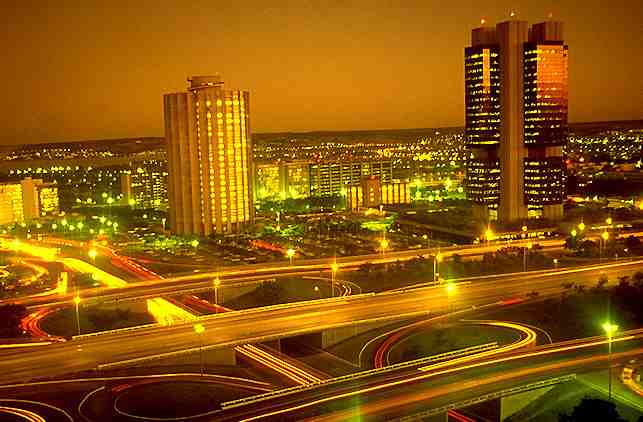
Brasilia, Federal capital city of Brazil
By Paul Arhewe

Brazil, it has been reported, has overtaken United Kingdom (UK) to become the sixth-largest economy in the world! Brazil's economy is now worth $2.52 trillion compared to UK's $2.48 trillion. Also stunningly, the forecast is that Brazil's economy would overtake the fifth biggest economy by the end of this year. As Nigerian I feel depressed by the underperforming capability of my dear country. Brazil does not only share similar characteristics with Nigeria, in the 1980s they were ranked together as developing countries. Like China and India with large human populations, Brazil was able to fight poverty through programs of market-oriented economic reforms which its government adequately and sincerely implemented. Among these former developing countries, China was the first to embark oneconomic reforms in the late 1970s, after 25 years of operating a controlled economy.