meetlancer

Tuesday, March 27, 2012

Who will save us from PHCN’s extortion?

PHCN workers
By Paul Arhewe

It is one annoying and disingenuous engagement. Staffers of the Power Holding Company of Nigeria (PHCN) are unrelenting in the extortion game. They subject the hapless consumers of the product that comes in trickles to pay outrageous bills. The merciless staffers of this government agency whose services are usually epileptic and scarcely available have taken it as their right to distribute falsified bills even when officials of the corporation have stopped reading electric meters. Let them tell Nigerians what it is if their management allocates targets to them without care whether their consumers get services or not?

In past I have paid many of these exorbitant bills even when there is no commensurate power supply, sometimes less than eight hours provision of power in a month. I have heard several complaints from Nigerians saddled with similar burden of exploitations.

Tuesday, March 20, 2012

Brazil’s miracle worker

Brazillian ex-president, Lula da Silva
By Paul Arhewe

In my last week’s piece titled, ‘Between Nigeria and Brazil’, I narrated the positive strides Brazil has attained in the last two decades to become the world’s sixth largest economy. It is interesting to note that while this tall achievement is laudable, it would not have come easily without the immense contributions of two outstanding leaders’ resounding legacies. Fernando Henrique Cardoso, 34th President (1995-2003) laid the solid economic foundation that took Brazil into the BRICS status, and for this he was named the ‘miracle worker’. His successor, Luiz Inacio Lula da Silva, completed and consolidated the economic transformation of Brazil.

The exploits of these two well focused leaders have again established the positive correlation between quality leadership and fortunes and health of a nation. Before the rise of Cardoso, Brazil was enmeshed in enervating debt burden, she was then the world’s third most indebted country. Amidst this sorry state of affairs Cardoso as a foreign minister in 1993, brought about transformational changes by slashing the country’s average import tariffs from 80 percent to 14 percent.

Wednesday, March 14, 2012

Between Nigeria and Brazil

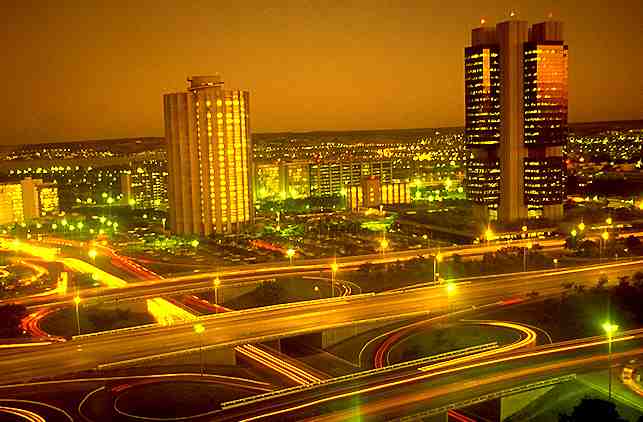
Brasilia, Federal capital city of Brazil
By Paul Arhewe

Brazil, it has been reported, has overtaken United Kingdom (UK) to become the sixth-largest economy in the world! Brazil's economy is now worth $2.52 trillion compared to UK's $2.48 trillion. Also stunningly, the forecast is that Brazil's economy would overtake the fifth biggest economy by the end of this year. As Nigerian I feel depressed by the underperforming capability of my dear country. Brazil does not only share similar characteristics with Nigeria, in the 1980s they were ranked together as developing countries. Like China and India with large human populations, Brazil was able to fight poverty through programs of market-oriented economic reforms which its government adequately and sincerely implemented. Among these former developing countries, China was the first to embark oneconomic reforms in the late 1970s, after 25 years of operating a controlled economy.

Tuesday, March 6, 2012

FG’s unsure SURE-P policy

President Goodluck JOnathan
By Paul Arhewe

The imbroglio that greeted Federal Government's petrol subsidy removal in January coerced it to quickly embark on transformational campaigns. The Goodluck Jonathan administration used every available media and forums to propagate what Nigerians stand to benefit if the total subsidy on the produce is discarded. Palliatives to cushion the foretold suffering the common masses would experience when the full policy implementations began were hurriedly both announced and promise.

No sooner the representatives of Federal Government and Nigerian Labour Congress (NLC) met to broker partial removal of subsidy than the government put on a new garb and changed its transformational campaigns into a transitional paradigm. To me, that overt departure was the initial signs signifying that the surety in this Subsidy Reinvestment and Empowerment (SURE) Programme (SURE-P) is really uncertain.

Tuesday, February 28, 2012

Lessons from Abdulmutallab’s strayed act

Abdulmutallab
By Paul Arhewe

Penultimate Thursday, US Federal Judge Nancy Edmunds convicted the Nigerian underwear bomber, Umar Farouk Abdulmutallab and sentenced him to multiple life jail. Rationalising the sentence, the judge had said: “This was an act of terrorism that cannot be quibbled with.” The 25 year-old Nigerian, from an affluent and well cultured family, was indoctrinated after persistent listening and watching of internet videos containing radical teachings from the late Arabian Peninsula based Al-Qaeda Islamist cleric, Anwar al Awlaki.

Umar Farouk, like some youths from wealthy homes residing outside the shores of the country, had lived an affluent lifestyle. He had money and the means to move from country to country; he also had ample liberty to choose the type of lifestyle to pursue. After being indoctrinated in Yemen and having found a new faith, the former engineering student at University College London and youngest out of 16 children of Alhaji Umaru Mutallab, a former banker sent text messages to his parent urging them to “... just forget about me, I’m never coming back… Please forgive me. I will no longer be in touch with you… Forgive me for any wrongdoing, I am no longer your child.”

Tuesday, February 14, 2012

Unending wait for improved power supply


By Paul Arhewe

One wonders if the exclamation: " Up NEPA" whenever electric power is restored in any part of the country is still right, especially now that the Power Holding Company of Nigeria (PHCN) has been taken over by 18 successive companies.

The Federal Government aims to bring about effective delivery of electric power; hence the monopoly the electricity giants (NEPA and PHCN) enjoyed over the years may give way for the much touted deregulation of the power sector. However, I don't think any other government agency or corporation has caused Nigerians the kind of nightmare they suffer in the hands of the PHCN or NEPA, while the latter existed. Till date, the corporation' s services are still growing from bad to worse, despite the huge fund the FG allocates to the power sector. When President Goodluck Jonathan took over the mantle of power, like the predecessors before him, he promised to declare a state of emergency in the sector. The nation has been waiting to see the Jon- athan miracle. For over ten years, stories of unbundling NEPA, or is it the PHCN now, have been running. But from lack luster manner the FG is handling the process indicates that the true deregulation of the poor is still neither here nor there. That the FG has set aside N100.7million in this year s budget, and from the country's dwindling resources, for powering generators in Aso Rock, is an indication that Nigerians have a long period to wait before the dawn of better power supply. It is like the journey of the Israelites to the Promised Land.

Tuesday, February 7, 2012

Delayed sacking of five governors

Chief Justice of Nigeria, Dahiru Musdapher
Many people hailed the recent ruling of the Supreme Court which sacked five governors who had overstayed their fixed tenure in office. The court held in its ruling that the tenures of Governors Timipre Sylva of Beyalsa, Murtala Nyako of Adamawa, Aliyu Magatakarda Wamakko of Sokoto, Ibrahim Idris of Kogi and Liyel Imoke of Cross River states expired since last year.


This development has once again showcased the existing principle of checks and balances which every ideal democratic state should practice. Nevertheless, the decision of the country's apex court is laudable and impressive; but the timing, to me, is unnecessarily delayed, and should have come earlier. A Federal High Court had held earlier that their tenures began to run from the day of their last oaths of office and allegiance, which they took after their re-election, following the nullification of the first poll that brought them to office. It is not enough that the Supreme Court faulted the decisions of the Federal High Court and the Appeal Court in this case. It should not end there. There ought to be a synergy between the lower and upper Bench, possibly by way of some explicit guidelines to help lower courts not to misdirect themselves.

Tuesday, January 31, 2012

New police boss and Nigeria’s security challenges

Mohammed Abubakar, Nigeria Acting IG of police
The emergence of Mohammed Dikko Abubakar as Nigeria's new Inspector- General of Police (IGP) came at a time when the country is inundated with a plethora of security challenges that are threatening its sovereignty and the peaceful coexistence of its people. Apart from the ubiquitous and incessant terrorist attacks by the Boko Haram sect, Nigeria is currently besieged by rising crime, kidnapping, swindling cyber fraud, etc., among other nefarious acts that have continued to damage the image of the country.


These challenges have also exposed the inefficiency of Nigeria Police Force which lacks the training to combat contemporary security threats. In recent times, dare devil robbers and terrorists take their battles to the doorstep of the police and escape with ease after their deadly attacks. The Boko Haram attack on the Force Headquarters in Abuja last year and the recent mayhem members of the same sect unleashed on a Kano police station really testify to the calibre of police the country now has and the dire need to overhaul the entire police apparatus and equip the rank and file with training on modern policing.

Tuesday, January 24, 2012

The real fuel cabal and saboteurs

The word cabal, a coinage from cabalocracy, became more pronounced during the recent anti-fuel subsidy removal strike and protests. It was the recurring term Nigerians used to condemn in unequivocal terms, those short-changing them under the cover of fuel subsidy. While all attention focused on the invisible and faceless economic saboteurs, Nigerians must not forget that the economic felons could not, on their own, milk the country dry without readily available official collaborators and accomplices.

It won't be strange to say that the majority of Nigerians occupying various spheres of human endeavour in the country are enslaved under the burden of corruption. However, the intimidating aspect of this is when those who consider themselves clean are disappearing, or battling with their resolve to remain steadfast. Nevertheless, the murky enticement corruption offers is making many to compromise or lose faith as they see the situation as irredeemable.

Tuesday, January 17, 2012

Why government can’t subdue Nigerian protesters

Nigerians protesting fuel subsidy removal
In recent times the world has witnessed several protests and revolutions in countries where people are dissatisfied with their governments. The Arab Spring started with one man in Tunisia, when Mohammed Bouazizi set himself alight and the fallout was the dethronements of the Tunisian President , Zine el Abidine Ben Ali.

In Egypt and Libya, President Hosni Mubarak and Muammar Gaddafi respectively lost out in the power game. While the latter paid with his life and those of some of his children, Mubarak who is bedridden, is currently undergoing trial for mass killings while his Tunisian counterpart is in exile in Saudi Arabia. In all these anti-government protests, despite the killings and maiming, running into thousands, the people usually emerge victorious. For instance in Syria, President Bashar al-Assad has killed over 6,000 people since last March to suppress the protest calling for his ouster. Despite this high death toll the protesters are still unrelenting.